
What Students Can Learn About Consumer Rights from Automotive Warranty Disputes
Most students do not think about consumer rights until something they depend on suddenly fails.
A laptop freezes during finals week. A phone stops working right when the warranty terms become confusing. A car keeps returning to the repair shop even though the service center keeps saying the issue has been fixed. At first, the goal feels simple: get the problem repaired and move on.
The real lesson begins when the problem comes back.
Automotive warranty disputes give students a practical way to understand consumer rights because they show what happens when a promise, a product, and a paper trail all collide.
The issue is not only whether something broke. The bigger question is whether the consumer can show what was promised, what went wrong, how often it happened, and what was done about it.
The Real Lesson Starts Before the Dispute
Consumer rights may sound like a legal topic, but students deal with them constantly.
Every warranty, lease, subscription, repair policy, service contract, campus housing agreement, insurance form, and online purchase carries expectations. Someone promises a product will work, a service will be delivered, a repair will be handled, or a policy will be followed.
When the result falls short, the consumer with organized proof usually has a stronger position than the consumer relying on memory alone.
Promise, Problem, Proof, Pattern, Escalation
A useful way to understand almost any consumer issue is through five simple steps:
- Promise: What did the warranty, seller, manufacturer, or service provider agree to do?
- Problem: What failed, when did it fail, and how did it affect normal use?
- Proof: What records show the issue happened?
- Pattern: Did the same problem return after repairs or complaints?
- Escalation: Has the normal repair or complaint process stopped working?
One repair visit is an event. Repeated symptoms, repeated repair attempts, and repeated lost use can become a pattern. That pattern often creates the clearest consumer-rights lesson.
Why Warranty Literacy Matters for Students
A warranty is more than a booklet tucked into a glove box or an email nobody reads. It is a written promise by a company about what it will do if a product fails under certain conditions.
The Federal Trade Commission explains that written warranties on consumer products carry legal responsibilities, and federal law limits how sellers can avoid implied warranty obligations when they offer written warranties or service contracts.
Know What Was Actually Guaranteed
Students do not need to memorize every legal detail, but they should know where the promise is written and what it covers.
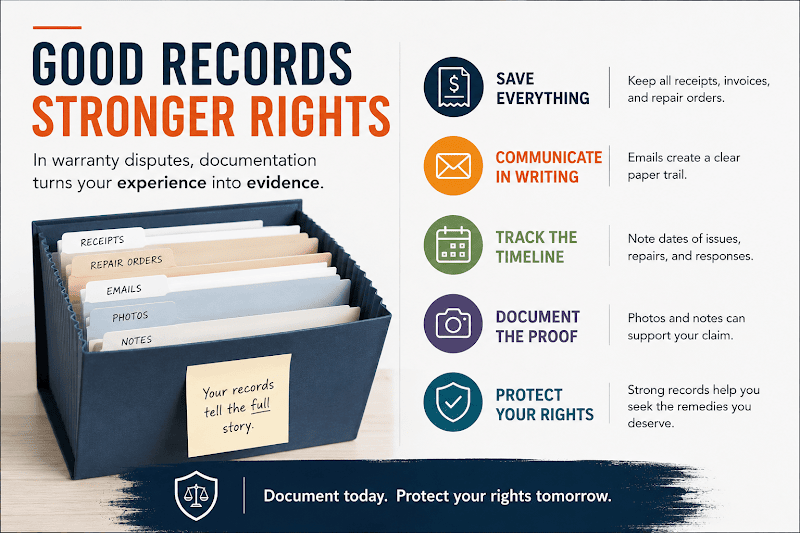
Before a dispute begins, save the purchase confirmation, warranty terms, repair paperwork, emails, receipts, service notes, and written explanations from the seller or manufacturer. Those documents define the starting point if the company later says the problem was not covered, not reported, or already fixed.
When a Vehicle Problem Becomes a Student-Life Problem
Car warranty disputes make consumer rights easier to understand because the stakes are real.
Reliable transportation can affect class attendance, part-time work, internships, family responsibilities, and basic daily stability. Trellis Strategies found that over one-quarter of students in its Student Financial Wellness Survey reported sometimes or rarely missing class due to unreliable transportation to campus.
A repair invoice may show one mechanical problem. The student’s life may show something larger: missed labs, late shifts, ride-share costs, lost study time, canceled plans, and the stress of not knowing whether the next repair will finally work.
A warranty repair may be free. The disruption around it rarely feels free.
How to Build a Record That Protects You
The most common consumer mistake is treating every repair like a separate incident.
A student drops off the car, explains the issue, picks it up, and hopes the problem is gone. A few weeks later, the same issue returns. By then, details start to blur. Was the part replaced or only inspected? How many days was the car unavailable? Did the service center write down the complaint accurately? Did anyone promise that the repair would solve the problem?
Good records answer those questions.
What to Save
Keep the purchase date, warranty documents, repair orders, mileage at the time the issue started, dates of each visit, service center notes, emails, text messages, photos, videos, receipts, and any written promise from the company.
What to Track
Write down the symptoms reported, how long the vehicle stayed out of service, whether the same issue returned, and how the problem affected school, work, transportation costs, or daily obligations.
What to Ask For
Ask the repair facility for a written explanation of what was inspected, repaired, replaced, or ruled out. If the explanation happens by phone, send a short follow-up email confirming what was discussed.
Clear documentation does not make a broken product work again. It makes the consumer’s story organized, credible, and harder to dismiss.
When Repeated Repairs Deserve a Closer Look
Not every failed repair becomes a consumer-rights issue. A second appointment may solve the problem. A delayed part may explain the wait. A first diagnosis may miss something.
Repeated failure is different.
Vehicle defects are also more common than many people assume. NHTSA reported 997 safety recalls involving vehicles and vehicle equipment in 2025, with more than 29 million vehicles recalled in the United States. The agency also notes that millions of recalls go unrepaired or unaddressed each year.
When a vehicle issue may involve safety, students should check for open recalls, complete needed repairs, and keep proof of every step.
A Calm Escalation Ladder Students Can Use
Escalation works best when it is organized, not emotional.
Start by reviewing the warranty and repair orders. Ask the service center for written explanations. Check for open recalls when safety may be involved. Contact the manufacturer or company in writing. Share the timeline, attach key records, and ask for a clear next step.
If the same covered defect keeps returning, legal awareness may become part of the picture.
California consumer guidance explains that the Lemon Law can involve a reasonable number of repair attempts, with the Lemon Law Presumption depending on warranty coverage, early ownership limits, and whether the defect affects the vehicle’s use, value, or safety.
For a student, parent, or recent graduate repeatedly dealing with the same covered defect, speaking with a Burbank lemon law attorney can help clarify whether the repair history suggests options beyond another service appointment.
The goal is not to turn every repair frustration into a dispute. The goal is to recognize when the ordinary process has stopped solving the problem.
Consumer Habits That Apply Beyond Cars
Automotive warranty disputes are only one example.
The same habits apply when a laptop fails during the semester, a landlord ignores a maintenance request, a phone warranty claim gets denied, an online order arrives damaged, a subscription keeps billing after cancellation, or a service provider fails to deliver what was promised.
The setting changes. The principle stays the same.
Save the promise. Define the problem. Keep the proof. Watch for patterns. Escalate with a clear record, not scattered frustration.
Final Takeaway: Strong Records Create Stronger Consumer Rights
Consumer rights are easiest to protect before a dispute becomes complicated.
A clear record, a calm timeline, and written proof can turn a frustrating repair problem into something a consumer can explain, support, and escalate when needed.
Automotive warranty disputes give students a practical lesson they can carry into every major purchase, lease, service agreement, or contract they sign later in life.
The strongest consumers are not the loudest in the room. They are the ones who pay attention early, keep the proof, ask clear questions, and know when one more repair appointment is no longer enough.